Email Infrastructure for SaaS: What Production Email Needs
SaaS email needs are unique — transactional reliability, promotional safety, growing volume, and reputation that scales with your product.
SaaS companies have a distinctive relationship with email. Your product generates transactional email (password resets, OTPs, alerts) and your growth team sends promotional email (onboarding sequences, feature announcements, re-engagement campaigns). Volume grows with your user base — sometimes unpredictably. And your email infrastructure directly affects user experience: if your OTP emails land in spam, users can't log in. The right SaaS email infrastructure isn't a single ESP — it's a stack of decisions about deliverability, reputation isolation, automated protection, and APIs. This guide covers what SaaS teams actually need from infrastructure email, beyond the basics of just sending mail.
The SaaS Email Stack
A typical SaaS application generates several categories of email. Authentication emails (OTPs, password resets, verification) need sub-second reliability. Notification emails (usage alerts, billing reminders, system status) need consistent delivery. Onboarding emails (welcome sequences, getting started guides) need good inbox placement to drive activation. Marketing emails (feature announcements, newsletters) need to send at scale without affecting the other categories. Most SaaS teams start with a single email provider and a single sending domain. This works until the first time a marketing campaign damages their domain reputation and their OTP emails start landing in spam.
Transactional Reliability Is Non-Negotiable
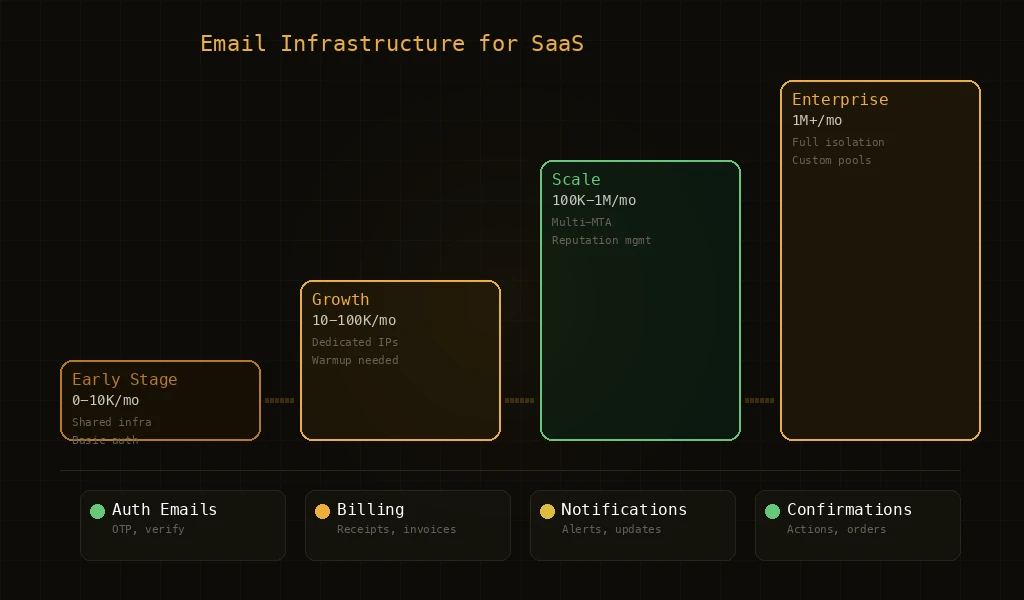
- Authentication Emails: OTPs and password resets are the foundation of your user experience. If these emails don't arrive within seconds, users can't access your product. Any email infrastructure that compromises transactional delivery is unsuitable for SaaS.
- Billing and Payment Emails: Invoice emails, payment failure notifications, and upgrade confirmations have legal and financial implications. These must be delivered reliably and to the inbox.
- System Notifications: Usage limit warnings, security alerts, and account status changes keep users informed about their account. Missing these creates support burden and user frustration.
- User Action Confirmations: When a user takes an action in your product — creates a team, changes settings, exports data — confirmation emails provide a record. These are expected immediately.
The Reputation Isolation Problem
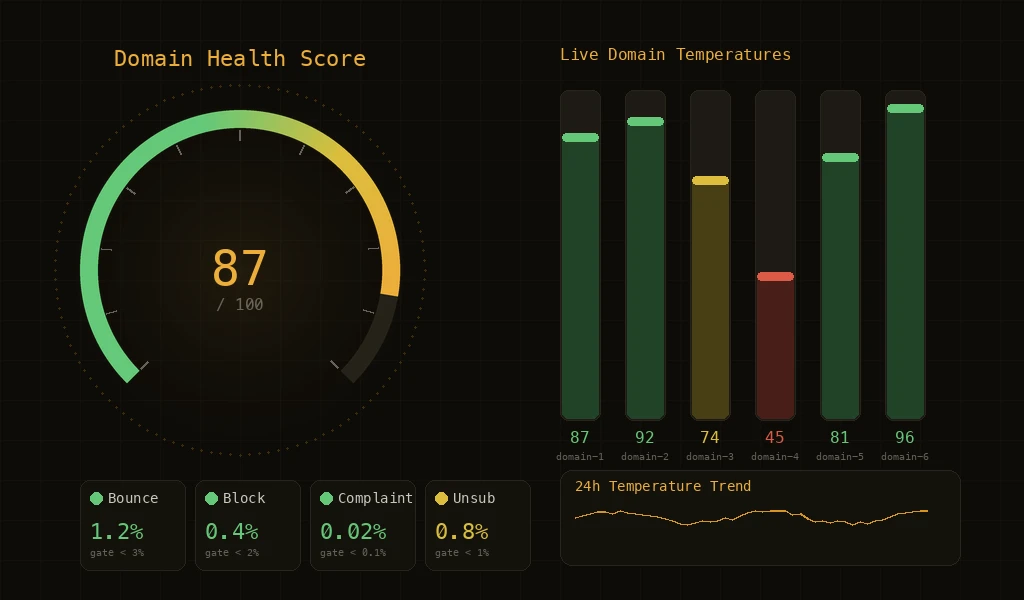
The most common email infrastructure mistake SaaS companies make is sending all email types from the same domain without reputation isolation. When a product growth experiment sends a re-engagement campaign to 50,000 inactive users and generates a 0.5% complaint rate, that complaint rate doesn't just affect the marketing email — it affects every email from that domain, including OTPs. Reputation isolation means tracking and managing reputation separately for different types of sending. This can be achieved through separate sending domains, separate subdomains, or — most effectively — through a platform that provides campaign-level reputation tracking that isolates the impact of one sending activity from another.
Scaling Email With Your Product
- Early Stage (0-10K Monthly Emails): At this stage, email infrastructure needs to be simple and reliable. A free tier with smart warmup is sufficient. The primary concern is establishing domain reputation from the start — not scaling.
- Growth Stage (10K-100K Monthly Emails): Volume grows with users. Multiple email types need different treatment. This is when reputation isolation becomes important — separating transactional from promotional sending. Analytics become necessary to track deliverability by email type.
- Scale Stage (100K-1M+ Monthly Emails): At scale, automated reputation management is essential. Manual monitoring can't keep up with the volume of signals. Engagement-based limits prevent growth from outpacing reputation. Multiple sending domains may be needed for different use cases.
- Enterprise Stage (Multi-Million Monthly): Enterprise SaaS requires dedicated infrastructure, custom rate limits, priority support, and detailed compliance controls. Multi-region sending may be necessary for latency and data residency requirements.
API-First Integration
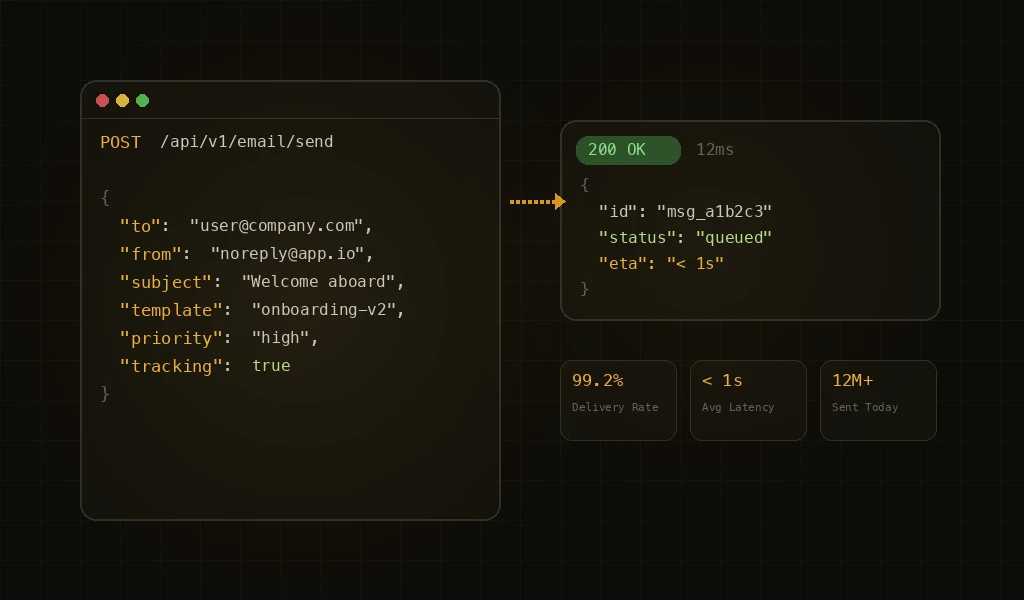
SaaS email infrastructure must be API-first. Your engineering team needs to integrate email sending into your application code, CI/CD pipelines, and monitoring systems. An email platform designed primarily for marketing users (with API as an afterthought) creates friction for engineering teams. Look for platforms that provide clean REST APIs, official SDKs in your tech stack's language, full webhook event coverage, and developer-friendly documentation. The integration should feel natural in your codebase, not like bolting on an external marketing tool.
Choosing Email Infrastructure for SaaS
When evaluating email infrastructure, SaaS teams should prioritize: transactional reliability (sub-second delivery for authentication emails), reputation isolation (marketing problems shouldn't affect transactional delivery), automated protection (the platform should handle reputation management, not your engineering team), scalability (the platform should grow with your user base without requiring infrastructure changes), and developer experience (clean APIs, good documentation, official SDKs). Cost matters, but it should be evaluated as total cost — including the engineering time to manage deliverability, the support cost of email-related user issues, and the revenue impact of poor inbox placement.
Key Features
Production-Ready Infrastructure
Email infrastructure designed for SaaS applications — reliable transactional delivery, reputation isolation, and automated scaling.
Developer-First APIs
Clean REST APIs, official SDKs, webhook events, and detailed documentation built for engineering teams.
Frequently Asked Questions
What is email infrastructure for SaaS?
Email infrastructure for SaaS is the layered system a software company runs to send transactional and promotional email reliably at production scale. It typically includes a sending platform or ESP, authentication setup (SPF/DKIM/DMARC), separate sending domains for different mail classes, monitoring and alerting, and a reputation-management layer that automatically reacts to bounces, blocks, and complaints. Building it right is what keeps OTP emails landing in the inbox under load — even when growth pushes volume 10× in a month.
Should SaaS companies build email infrastructure or use a provider?
For almost every SaaS team under enterprise scale, the answer is to use a provider — but choose one that handles infrastructure email correctly. Building your own MTA fleet, managing IP reputation, and tracking ISP feedback loops is a multi-engineer-year investment that doesn't differentiate the product. The exception is companies whose volume or compliance requirements (regulated industries, very high transactional volume) make a provider economically or operationally untenable.
What's the difference between transactional and promotional email infrastructure?
Transactional email infrastructure is optimized for low-latency, high-reliability delivery — OTPs, password resets, billing alerts. Latency budgets are seconds, reliability targets are 99.9%+. Promotional infrastructure is optimized for safe, throttled bulk sending — onboarding sequences, newsletters, re-engagement. Volume can be much higher, but the deliverability risk profile is different (engagement signals, complaint rates, list hygiene). Mature SaaS teams isolate the two onto separate sending domains and IP pools so a promotional incident never throttles transactional delivery.
What is reputation isolation in SaaS email infrastructure?
Reputation isolation means sending different classes of email from different domains (or subdomains) and IP pools so that one class can't poison another. The classic mistake is sending OTPs and a re-engagement campaign from the same root domain. If the campaign generates complaints, ISPs throttle the whole domain — and now password-reset emails are also delayed. Isolated infrastructure (e.g., otp.yourdomain.com and updates.yourdomain.com on separate IP pools) contains incidents to the affected slice instead of cascading them across all sending.
What does an API-first email infrastructure look like for SaaS?
API-first means every operation — sending, template management, suppression lists, reporting, sender ID rotation, webhook configuration — is available as a first-class HTTP API or SDK. Your engineering team can integrate email into application code, CI/CD pipelines, and monitoring systems without going through a dashboard. Mature platforms also expose deliverability state (current sending speed, domain health score, queued message count) so you can build production guardrails into your own services.
Further Reading
For more tutorials and deep dives, head back to the blog.