Adaptive Rate Limiting in Email: How ISP Feedback Controls Sending Speed
Static rate limits don't work at scale. Learn how adaptive systems use live ISP feedback to control sending speed and prevent reputation damage.
When you send email at scale, every ISP responds differently. Gmail might accept 500 emails per minute from your domain while Outlook throttles you at 200. Yahoo might block you entirely after a complaint spike. Static rate limits — the same speed regardless of ISP response — are a blunt instrument that either under-utilizes your capacity or overwhelms ISPs until they push back. Adaptive rate limiting is the practice of dynamically adjusting sending speed based on live ISP feedback signals. It's the difference between driving with your eyes closed at a fixed speed and driving with full awareness of road conditions.
What ISP Feedback Signals Tell You
- Bounces (Hard and Soft): Hard bounces indicate permanent delivery failures — invalid addresses, non-existent domains. Soft bounces are temporary — mailbox full, server temporarily unavailable. A rising bounce rate signals list quality problems or infrastructure issues.
- Blocks: When an ISP actively rejects your email with a 5xx error, that's a block. Blocks are more serious than bounces — they indicate the ISP has made a deliberate decision to refuse your traffic. Even a small number of blocks should trigger immediate speed reduction.
- Deferrals: A deferral (4xx response) means the ISP is saying 'try again later.' This is the ISP telling you to slow down. Repeated deferrals from the same ISP are a clear signal to reduce sending speed to that provider.
- Complaint Feedback Loops: When recipients mark your email as spam, ISPs report this through feedback loops. Complaints are the most damaging signal — a complaint rate above 0.1% for any ISP is a serious warning that requires immediate attention.
Why Static Rate Limits Fail
Static rate limits assume all ISPs behave the same way and all sending conditions are constant. Neither is true. A static limit of 1,000 emails per minute might be perfectly safe for Gmail on a good day but catastrophically high for a smaller ISP that's already showing deferral signals. Static limits also can't respond to sudden changes — if an ISP starts blocking your emails at 2pm, a static system will keep sending at the same rate until a human notices and intervenes. By then, significant reputation damage may have occurred.
How Adaptive Rate Limiting Works
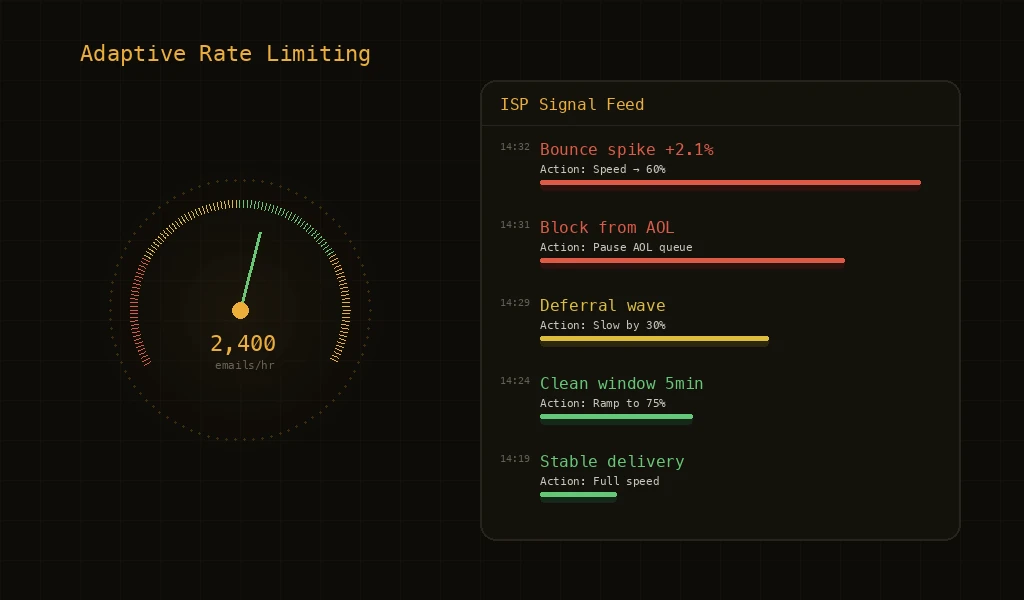
An adaptive system processes ISP feedback within seconds and adjusts sending speed accordingly. When bounce rates rise, sending slows down. When blocks appear, speed drops significantly. When deferrals increase, the system backs off and retries later. When signals are clean, speed gradually increases back to maximum capacity. The key principle is proportional response — the severity of the speed adjustment matches the severity of the signal. A few soft bounces might cause a minor slowdown. A block from a major ISP triggers an immediate significant reduction. A complaint spike might pause sending entirely until the source is identified.
Real-time vs Batch Processing
- Traditional Batch Approach: Many platforms check delivery metrics once per hour or once per day. This means problems can persist for hours before any corrective action is taken. For high-volume senders, hours of unchecked sending against a hostile ISP can cause lasting reputation damage.
- Continuous Signal Processing: Adaptive systems process ISP signals continuously — every bounce, block, and deferral is analyzed as it arrives. This means the system can detect and respond to problems within minutes, not hours. The sending speed curve tracks ISP sentiment within minutes.
- Predictive Adjustment: Advanced adaptive systems don't just react — they predict. If bounce rates are trending upward even while still within acceptable ranges, the system can proactively reduce speed before the situation becomes critical.
The Recovery Side of Adaptive Limiting
Adaptive rate limiting isn't just about slowing down — it's equally important for speeding back up safely. After a sending slowdown, the system needs to verify that conditions have improved before restoring full speed. A naive approach would snap back to full speed immediately, which risks triggering the same problems again. A well-designed system uses gradual recovery — stepping speed back up incrementally and monitoring signals at each step. If signals remain clean through multiple recovery steps, full speed is restored. If problems reappear during recovery, the system drops back to a protective speed.
Impact on Deliverability
Platforms with adaptive rate limiting consistently achieve better inbox placement rates than those with static limits. The reason is straightforward: adaptive systems prevent the kind of ISP-punishing behavior that damages long-term reputation. A sender that briefly slows down when an ISP is stressed maintains a good standing with that ISP. A sender that hammers the ISP during stress gets blocklisted. Over time, ISPs develop trust patterns — senders that respect ISP signals consistently receive better treatment.
Key Features
Signal Processing
Continuous analysis of ISP bounces, blocks, deferrals, and complaints to calculate optimal sending speed.
Reputation Protection
Automatic speed adjustment prevents reputation damage before it occurs, preserving long-term deliverability.
Frequently Asked Questions
What is adaptive rate limiting in email?
Adaptive rate limiting is a control loop that adjusts how fast you send based on live ISP feedback — bounces, deferrals, blocks, and complaints — rather than enforcing fixed per-hour or per-day caps. When ISPs push back, the platform slows down; when signals are clean, it ramps up. The system reads, decides, and adjusts continuously, typically in seconds.
Why aren't static rate limits enough?
Static limits can't react to ISP behavior. If Gmail is throttling you on a Tuesday morning, a 100k/hour cap doesn't help — it just keeps pushing volume the ISP doesn't want, deepening the throttle. Conversely, if signals are clean, a static cap leaves throughput on the table. ISPs themselves run adaptive policies, so the only way to send at peak speed safely is to mirror that adaptiveness.
What ISP feedback signals drive rate adjustment?
Hard bounces (especially per-ISP), soft bounces and deferral codes (4xx tempfails), block codes (4.7.x and 5.7.x rejection categories), spam-folder placement signals, and complaint feedback loops. Some platforms also factor in connection-time signals like SMTP latency increases, which often precede explicit throttling.
How quickly should adaptive rate limiting react?
Reactivity depends on the signal class. Hard-bounce spikes and explicit block codes deserve immediate slowdown (seconds). Soft-bounce and deferral patterns can be smoothed over a 1–5 minute window. Engagement and complaint signals are slower (minutes to hours) because the underlying user action takes time. Best-in-class systems blend these into a single adaptive throughput target.
Does adaptive rate limiting hurt total throughput?
No — it usually increases total throughput. Static caps optimize for the worst case; adaptive systems run at the actual current ceiling. The slowdowns during incidents are more than offset by the ability to push faster when signals are clean. The net effect is higher inbox placement at peak volume, fewer reputation incidents, and less manual rate tuning.
Further Reading
For more tutorials and deep dives, head back to the blog.