Multi-Level Email Reputation: Why Tracking at Campaign, Domain, and Account Matters
IP-level reputation tracking misses most of the picture. Multi-level tracking at campaign, domain, and account catches problems before they spread.
When most people think about email reputation, they think about IP reputation — the score that ISPs assign to the IP address your email is sent from. IP reputation is important, but it is only one layer of a more complex picture. Modern email sending involves multiple entities: the sending IP, the sending domain, the campaign or activity that generated the email, and the account that owns everything. Each of these entities has its own reputation trajectory, and problems can originate at any level. Tracking reputation only at the IP level is like monitoring your company's financial health by looking only at its bank balance — it tells you the aggregate result but nothing about which departments are profitable and which are hemorrhaging money.
The Layers of Email Reputation
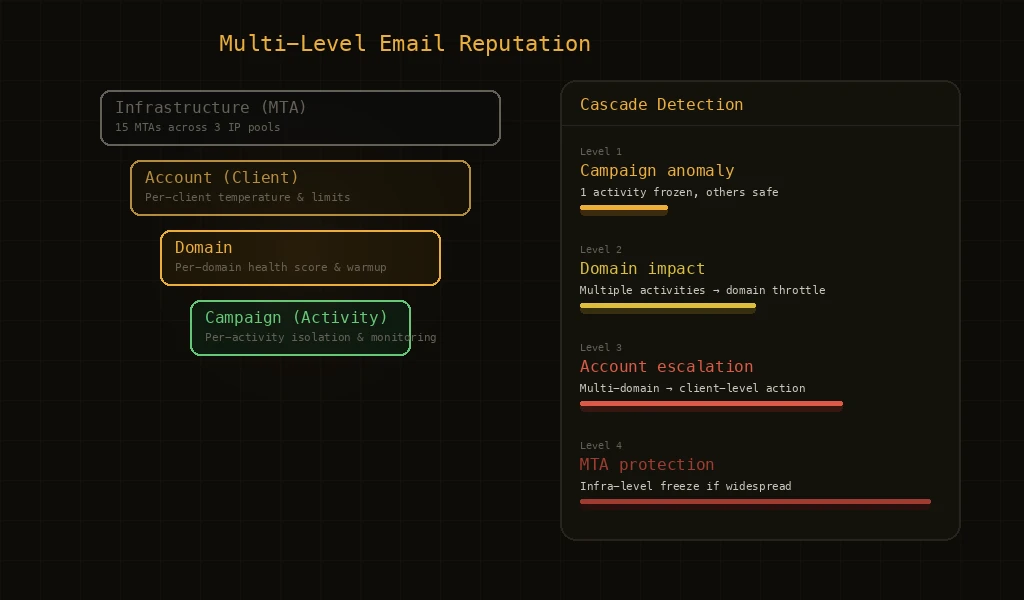
- Campaign-Level Reputation: Each campaign or sending activity has its own performance characteristics. A promotional campaign targeting cold subscribers will have different engagement patterns than a transactional campaign sending password resets. Tracking reputation per campaign lets you identify which specific sending activity is causing problems.
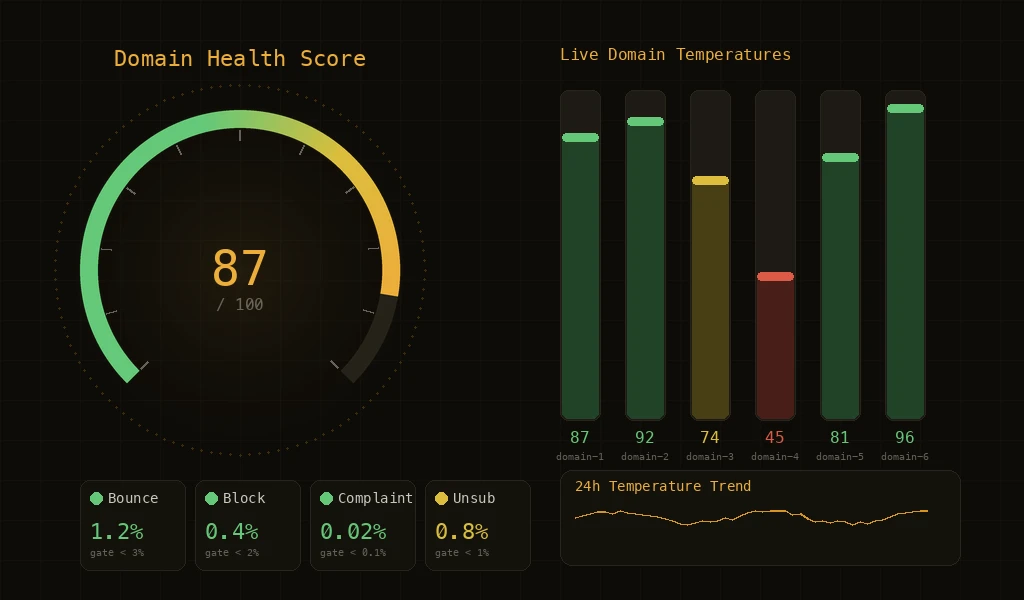
- Domain-Level Reputation: ISPs increasingly evaluate reputation at the domain level rather than (or in addition to) the IP level. Google's shift to domain-based reputation means your sending domain's history matters more than your IP's history. Domain-level tracking aggregates performance across all campaigns using that domain.
- Account-Level Reputation: An account may operate multiple sending domains. Account-level tracking looks at the aggregate health across all domains — useful for identifying systemic issues like list quality problems or content issues that affect all sending.
- Infrastructure-Level Reputation: The sending servers themselves carry reputation — ISPs track the behavior of sending infrastructure over time. Infrastructure-level monitoring ensures that no single account's problems degrade the sending environment for other accounts.
Why IP-Only Tracking Is Insufficient
IP reputation was the primary metric in the early days of email deliverability, and it remains important. But relying solely on IP reputation creates blind spots. Multiple senders sharing an IP (on shared infrastructure) means one bad sender's behavior affects everyone. Conversely, a sender on a dedicated IP might have excellent IP reputation while one of their domains is developing a poor reputation with specific ISPs. Google explicitly uses domain reputation as a primary signal. Microsoft weighs both IP and domain reputation. Yahoo and other ISPs have their own blends. Tracking only at the IP level misses the signals that modern ISPs actually use to make filtering decisions.
The Value of Campaign-Level Tracking
Campaign-level reputation tracking is where multi-level monitoring becomes most powerful for senders. Consider a common scenario: a SaaS company sends both transactional emails (password resets, order confirmations) and promotional emails (newsletters, product announcements) from the same account. Without campaign-level tracking, a poorly-performing newsletter campaign might drag down the overall metrics, potentially affecting transactional email delivery — which is exactly the opposite of what you want. With campaign-level tracking, the system can identify that the newsletter campaign has declining engagement and elevated complaints, and apply protective measures specifically to that campaign, while transactional emails continue sending at full capacity.
Cascade Analysis: How Problems Spread
- Campaign Anomaly Detection: The system first detects a problem at the campaign level — elevated bounces, blocks, or complaints for a specific sending activity. If the problem is isolated to one campaign, corrective action is applied only to that campaign.
- Domain Impact Assessment: If multiple campaigns using the same domain show problems, the system escalates to domain-level assessment. This indicates a domain-wide issue — perhaps a DNS misconfiguration, a blocklist listing, or a systemic content problem.
- Account-Level Evaluation: When multiple domains under the same account show degradation, the system evaluates at the account level. Account-wide problems suggest list quality issues, content policy violations, or other systemic factors.
- Proportional Response: At each level, the protective response is proportional to the scope. A campaign issue affects only that campaign. A domain issue affects all sending from that domain. An account issue may trigger account-wide restrictions. This proportionality minimizes impact on healthy sending.
Practical Benefits for Senders
Multi-level reputation tracking provides several concrete benefits. First, problem isolation — you know exactly which campaign, domain, or account is the source of an issue. Second, minimized impact — protective measures target the problematic entity, not your entire sending program. Third, faster diagnosis — when you receive an alert that Campaign X has a bounce rate anomaly, you know exactly where to look. Fourth, better capacity allocation — domains with strong reputation get more sending capacity while domains with issues get less, automatically.
Implementation Considerations
Multi-level tracking requires infrastructure that can process and analyze metrics at each entity level independently. This means maintaining separate reputation calculations for every campaign, every domain, and every account — each with its own thresholds, its own protection levels, and its own recovery trajectory. The computational cost is higher than simple IP-level tracking, but the precision of the response is dramatically better. For platforms handling thousands of campaigns across hundreds of domains, multi-level tracking is the difference between a scalpel and a sledgehammer.
Key Features
Layered Intelligence
Independent reputation tracking at campaign, domain, and account levels provides precise problem identification and targeted response.
Surgical Precision
Protective measures target only the affected entity — a problematic campaign won't disrupt your transactional email delivery.
Further Reading
For more tutorials and deep dives, head back to the blog.