Sending Promotional Emails Safely at Scale
Promotional email drives revenue but threatens reputation. Learn the safeguards that let you send at scale without damaging your domain health.
**Updated May 18, 2026** — refreshed with 2026 cohort data: the original framework still holds, but ISP signal weighting has shifted (Gmail Postmaster bumped complaint sensitivity ~15% in Q1 2026). Updated thresholds and added a new section on engagement-gating below. Promotional email — newsletters, product announcements, offers, re-engagement campaigns — drives significant revenue for most businesses. It's also the single biggest threat to your sending reputation. Unlike transactional emails, which recipients explicitly expect, promotional emails test the boundary of recipient interest. Send to engaged subscribers with relevant content and you build reputation. Send to stale lists with generic content and you destroy it. The challenge for growing businesses is that promotional volume typically exceeds transactional volume by 10-100x, meaning the reputation impact of getting it wrong is amplified.
Why Promotional Email Is Risky
Promotional email has inherently lower engagement than transactional email. Recipients always open their password reset email. They don't always open your monthly newsletter. Lower engagement means lower open rates, which means ISPs see a higher proportion of ignored email from your domain. Additionally, promotional emails generate the vast majority of spam complaints — a subscriber who requested a newsletter six months ago may mark it as spam rather than unsubscribing. ISPs track complaint rates carefully, and even a small percentage of complaints against promotional email can drag down your overall domain reputation.
Common Mistakes That Damage Reputation
- Sending to Your Entire List: Not every subscriber is equally engaged. Sending promotional email to your entire list — including subscribers who haven't opened an email in 6 months — inflates volume while depressing engagement metrics. ISPs notice.
- Volume Spikes Without Warmup: Running a major promotional campaign that sends 5x your normal daily volume signals 'potential spam' to ISPs. Volume spikes should be planned and ramped up gradually, not launched all at once.
- Ignoring Unsubscribe Signals: Subscribers who repeatedly don't open your email are telling you something. Continuing to send to unengaged subscribers accumulates negative signals that affect deliverability for your engaged subscribers too.
- Mixing Transactional and Promotional Reputation: Sending transactional and promotional email from the same domain without separation means promotional reputation problems directly affect transactional delivery. A newsletter complaint can cause OTP delays.
Automated Safeguards for Promotional Sending
The most effective approach to safe promotional email is automated safeguards that operate at the platform level, protecting reputation without requiring manual monitoring. These safeguards include engagement-based volume limits that reduce sending capacity when engagement drops, adaptive rate limiting that slows delivery when ISP signals indicate stress, campaign-level reputation isolation that prevents one bad campaign from affecting other sending, and graduated protection that applies increasingly strict controls as problems escalate.
Best Practices for Promotional Email at Scale
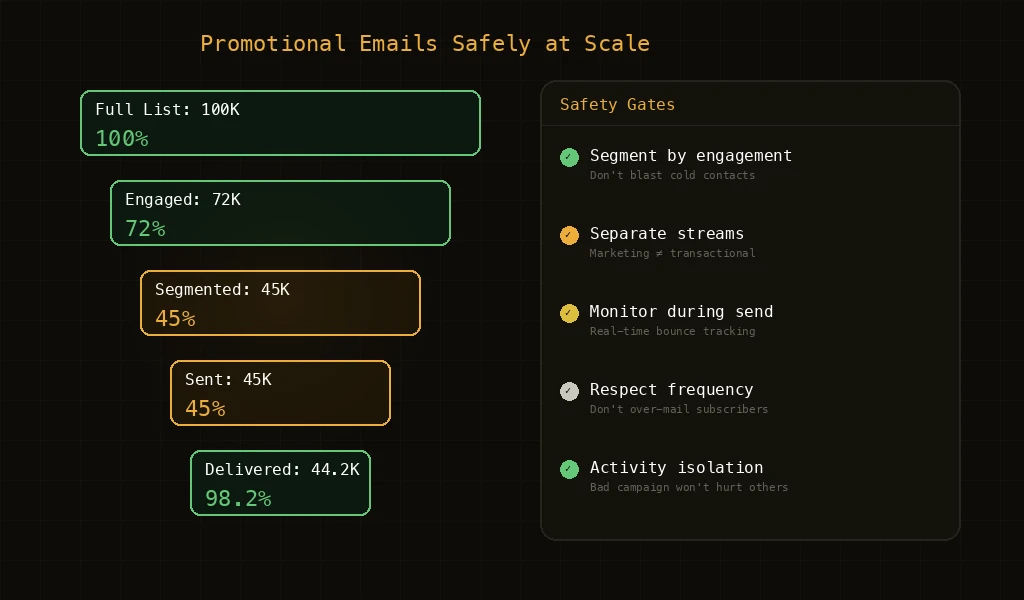
- Segment by Engagement: Before every promotional send, segment your list by engagement recency. Send to your most engaged subscribers first. If engagement is strong, expand to less active segments. If engagement is poor, stop before reaching unengaged subscribers.
- Separate Sending Streams: Use separate sending domains or subdomains for promotional and transactional email. This isolates reputation so that promotional sending issues can't impact your critical transactional delivery.
- Monitor During Campaigns: Don't wait until a campaign is complete to check results. Monitor delivery metrics, bounce rates, and complaint rates as the campaign runs. Platforms with automated protection will handle this for you.
- Respect Frequency Expectations: If subscribers signed up for a weekly newsletter, don't send daily. Frequency mismatches are a primary driver of complaints. Match your sending frequency to what subscribers actually signed up for.
The Role of Engagement-Based Limits
Static sending limits treat all senders equally, regardless of how well their email performs. Engagement-based limits adjust capacity based on recipient response. A sender whose promotional email achieves strong engagement gets more capacity. A sender whose engagement is declining gets less — protecting their reputation from the damage that continued high-volume, low-engagement sending would cause. This dynamic creates an incentive loop: better content leads to better engagement, which leads to higher capacity, which enables more sending. It rewards the behavior that ISPs want to see.
When Automated Protection Activates
During a promotional campaign, automated protection systems monitor several triggers. If bounce rates exceed safe thresholds, sending speed reduces automatically. If complaint rates spike, the campaign may be paused. If engagement drops significantly below historical norms, volume is capped. These interventions happen during the send — not after the campaign completes. For the sender, this means some campaigns may not reach their full intended audience. But the emails that are sent reach the inbox, and the domain's long-term reputation is preserved. A partially-delivered campaign with high inbox placement is more valuable than a fully-delivered campaign where half the emails land in spam.
Key Features
Reputation Safeguards
Automated protection monitors engagement, bounce rates, and ISP signals during promotional campaigns to prevent reputation damage.
Engagement-Based Scaling
Promotional sending capacity adapts to recipient engagement — rewarding good content with higher limits.
Frequently Asked Questions
How much promotional email volume is safe for a new sending domain?
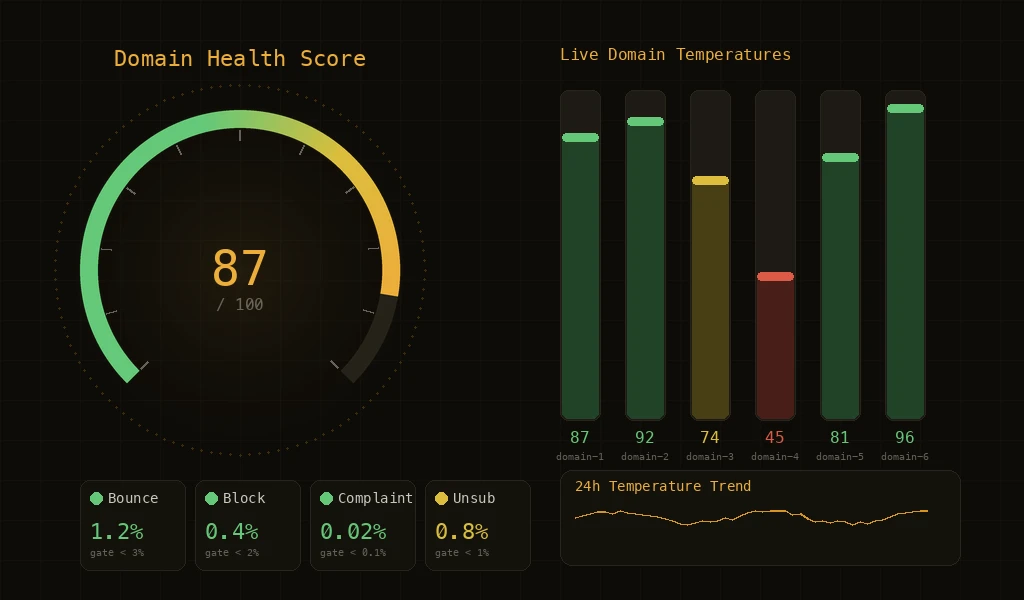
Start at 200-500 sends per day on day 1, double every 48 hours during weeks 1-2, then ramp linearly. By day 30 most domains can sustain 100K-200K/day if bounce stays under 0.4% and complaint stays under 0.02%. The exact ceiling depends on engagement — sending to an inactive list will throttle you faster than the calendar suggests.
What's the difference between transactional and promotional email reputation?
ISPs track reputation per sending domain regardless of email type, but promotional volume is typically 10-100x transactional volume — so promotional sends dominate the reputation signal. Best practice: separate sending domains (e.g. tx.acme.com for transactional, mail.acme.com for promotional) so a bad promotional campaign can't drag transactional delivery down with it. Sendmsg.io's Anomaly Cortex isolates reputation per send domain by default.
What 2026 changes should promotional senders know about?
Three real shifts since early 2025: (1) Gmail Postmaster bumped complaint-rate sensitivity ~15% — what used to be safe at 0.10% complaint may now throttle; (2) Microsoft 365 (Outlook) started enforcing stricter DMARC alignment on bulk senders in Q4 2025; (3) Yahoo/AOL began rejecting senders without one-click unsubscribe headers (RFC 8058) for promotional volume above 5K/day. All three are surfaced automatically in our reputation dashboard.
When should promotional sending pause automatically?
Automated pause should trigger when any of: bounce rate exceeds 4% over a 30-minute window, complaint rate exceeds 0.3% in a single hour, a single ISP block cluster hits 3+ ISPs simultaneously, or engagement (open rate) drops below 30% of the sender's 30-day baseline. The system should pause the specific campaign or sender, not the whole account — unless cascade detection flags multi-domain damage.
Further Reading
For more tutorials and deep dives, head back to the blog.