Email API Architecture for Scalable Delivery
Building an email API that handles both transactional and promotional sending at scale requires careful architectural decisions. Here's how the pieces fit together.
Modern email infrastructure needs to handle vastly different workloads — time-critical transactional messages that demand sub-second delivery alongside high-volume promotional campaigns that need reputation management. Building the API architecture to support both requires more than a simple send endpoint. A well-designed email API separates transactional and promotional concerns, provides consistent developer experience, and handles reputation protection transparently.
The Transactional vs Promotional Challenge
Transactional emails (OTPs, receipts, password resets) and promotional emails (campaigns, newsletters, marketing) have fundamentally different requirements. Transactional emails must be delivered instantly and should never be throttled. Promotional emails need reputation management, warmup controls, and engagement-based sending limits. A naive approach — routing everything through the same pipeline — risks throttling critical OTPs when a marketing campaign triggers reputation signals. The solution is architectural separation with shared intelligence.
API Design Principles
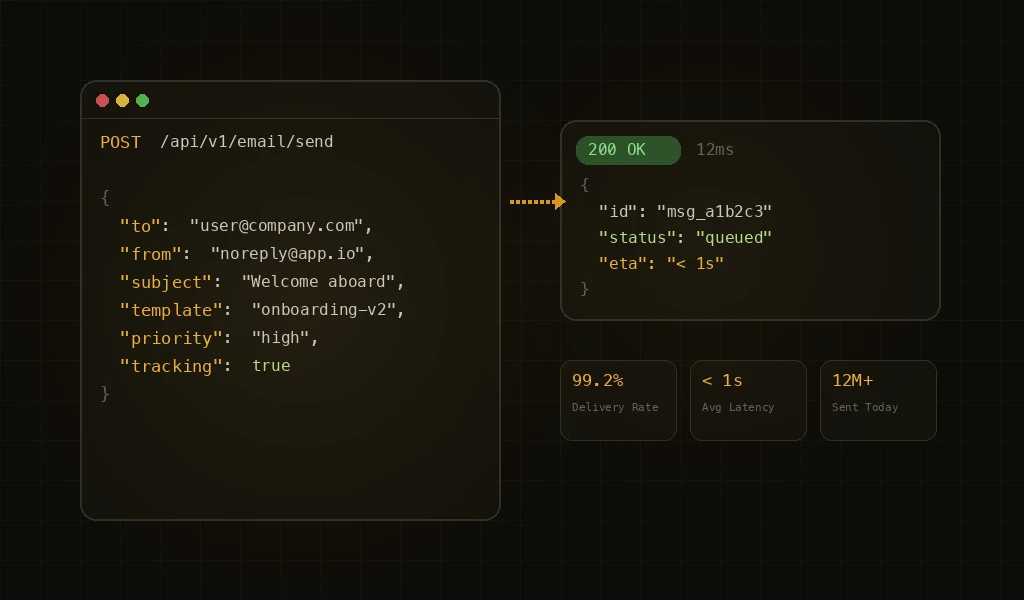
- Priority-Based Routing: Transactional emails marked with priority: 'high' bypass all reputation-based controls and enter a dedicated priority queue. Promotional emails flow through the standard pipeline where Reputation Shield manages sending speed and volume based on domain health signals.
- Consistent Resource Model: Whether sending a single transactional email or a campaign to thousands, the core API concepts remain consistent: messages, recipients, templates, and events. The same webhook format handles delivery notifications for both types.
- Unified Event Model: Delivery events — sent, delivered, opened, clicked, bounced — follow the same webhook format for both transactional and promotional emails. A developer handling a bounce notification uses the same code path regardless of email type.
- Shared Authentication: A single API key provides access to all email capabilities. Sending type is determined by the request parameters, not by separate authentication flows. This simplifies integration and reduces credential management overhead.
Queue Architecture
A production email platform requires sophisticated queue management. Transactional emails need a dedicated high-priority queue with guaranteed processing order and minimal latency. Promotional emails use standard queues where sending speed adapts based on domain health. Deferred emails (temporary failures) enter a retry queue with exponential backoff. Campaign emails are distributed across activity-specific queues for granular control. The queue system must handle all of this transparently — a developer sends an API request and the infrastructure routes it appropriately.
Reputation Intelligence Layer
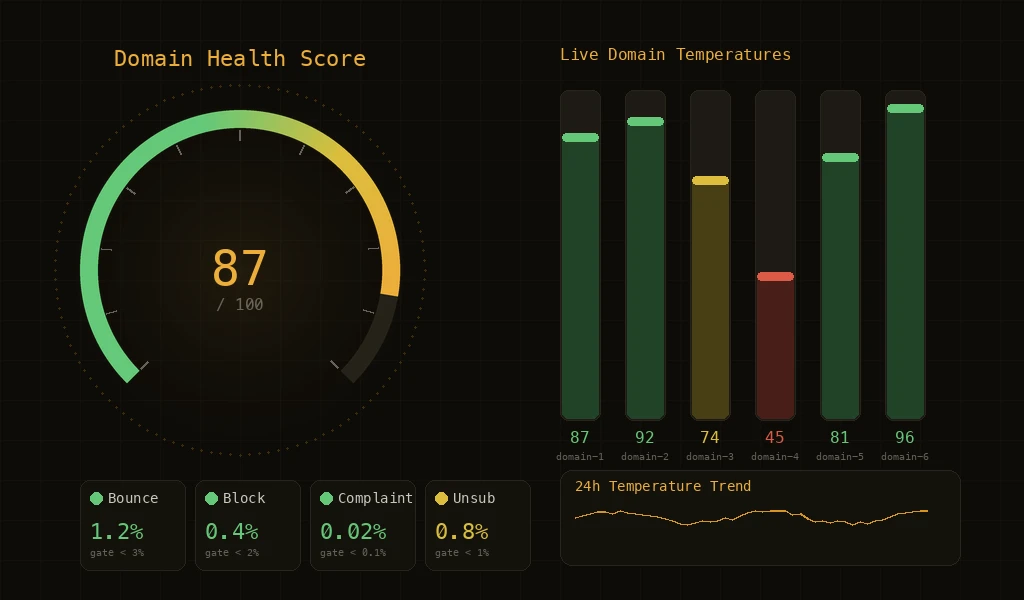
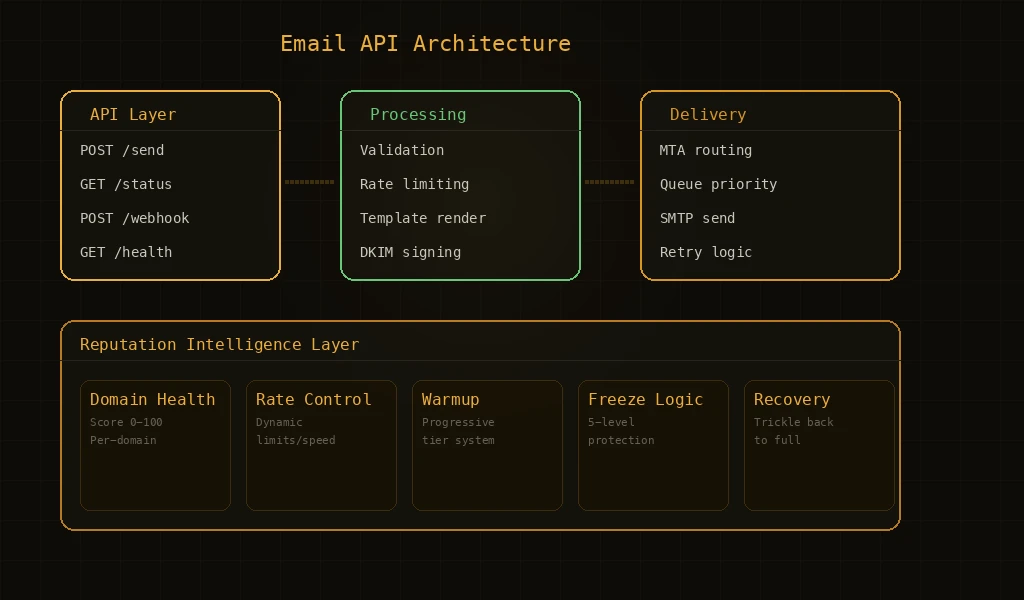
- Domain Health Scoring: Every sending domain gets a live health score from 0 to 100, blending ISP signals, bounce rates, complaint rates, and engagement metrics. This score drives promotional sending decisions without affecting transactional delivery.
- Adaptive Protection: When health signals deteriorate, the system automatically adjusts promotional sending speed. Five graduated levels — from monitoring to full pause — provide proportional response. Transactional emails always bypass these controls.
- Smart Warmup: New domains are automatically warmed up through graduated volume tiers. The API handles this transparently — developers don't need warmup schedules or manual volume management.
- Per-Entity Tracking: Reputation is tracked independently per campaign, per domain, and per account. A problematic campaign is throttled individually without affecting your other sending. This isolation is critical for platforms sending on behalf of multiple clients.
Campaign Automation Layer
Beyond one-off sends, a complete email API supports automated campaign orchestration. Sequential journeys send multi-step email sequences with configurable intervals and engagement-based progression. Smart rotation optimizes template selection based on historical performance. The automation layer respects domain limits, allocating daily capacity across automated and manual campaigns intelligently. All of this is exposed through clean API endpoints that let developers build sophisticated email workflows programmatically.
Idempotency and Reliability
In a high-volume email system, idempotency is critical. A network timeout during an API call shouldn't result in a double email delivery. Every API request should accept an idempotency key that ensures the same request processed twice produces the same result. This is particularly important for transactional emails — a duplicated OTP creates confusion, and a duplicated order confirmation erodes trust. The queue architecture should deduplicate at ingestion, and the delivery layer should verify against delivery logs before processing.
Key Features
Separated Architecture
Transactional and promotional emails use separated pipelines with shared intelligence for optimal delivery of both.
Reputation Intelligence
Domain health scoring, adaptive protection, and smart warmup built into the email delivery layer.
Further Reading
For more tutorials and deep dives, head back to the blog.