Graduated Freeze Systems: How Email Platforms Protect Sender Reputation Automatically
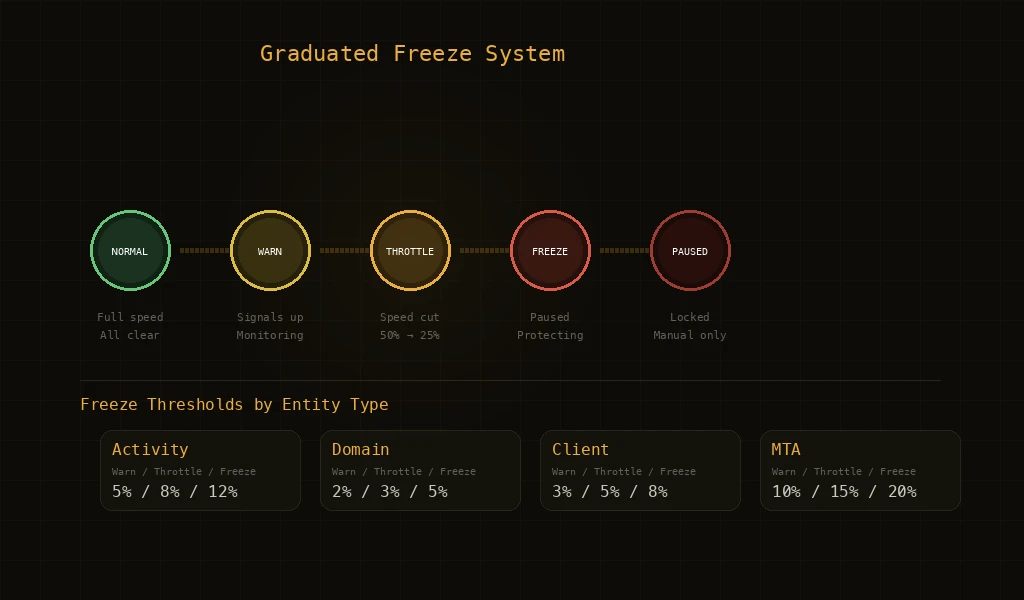
Binary on/off controls can't protect email reputation effectively. Graduated freeze systems respond proportionally to threats — here's how they work.
When your email sending starts causing problems — rising bounce rates, ISP blocks, complaint surges — the platform has to make a decision. The simplest approach is binary: either you're sending or you're not. But binary controls are a blunt instrument. Shutting down all sending because one campaign has issues punishes your entire operation. Letting everything continue running because most campaigns are fine allows the problematic campaign to cause lasting damage. Graduated freeze systems solve this by responding proportionally to threats, applying increasingly strict controls as problems escalate, and isolating the impact to the entities that are actually causing issues.
The Problem with Binary Controls
Most email platforms handle reputation problems in one of two ways: they either do nothing (leaving it to the sender to notice and fix), or they shut everything down. Neither approach works well. Doing nothing allows problems to compound — a rising bounce rate that goes unchecked for hours can damage a domain's reputation for weeks. Shutting everything down is overly aggressive — it interrupts legitimate sending and creates a poor user experience. The right approach is a graduated response that matches the severity of the intervention to the severity of the problem.
How Graduated Protection Levels Work
- Healthy — Normal Operation: All metrics are within acceptable ranges. Sending operates at full capacity with standard monitoring. The system continuously evaluates signals but takes no restrictive action.
- Caution — Early Warning: One or more metrics have crossed initial warning thresholds. The system increases monitoring frequency and may begin slight speed reductions. No sending is paused, but the system is paying closer attention.
- Throttled — Active Speed Reduction: Metrics have deteriorated further. Sending speed is actively reduced to limit the rate at which problems can accumulate. This gives ISPs time to process existing volume and gives the system time to evaluate whether the trend is worsening or stabilizing.
- Protected — Temporary Pause: Metrics have crossed critical thresholds. Sending is temporarily paused to prevent further reputation damage. The pause has a defined duration that increases with repeated escalations — a first-time pause is shorter than a second or third.
- Suspended — Extended Protection: Repeated escalations to the Protected state indicate a persistent problem. The system enters an extended protection mode that requires investigation and manual resolution before sending can resume.
Entity-Level Isolation
A critical feature of graduated systems is entity-level isolation. Instead of applying controls at the account level, the system tracks reputation at multiple levels — per campaign, per domain, and per account. This means a problematic promotional campaign can be throttled or frozen while transactional emails from the same account continue sending normally. This isolation prevents a single bad campaign from affecting your entire email program. Each entity's protection level is managed independently based on its own performance metrics.
Escalating Duration Logic
The duration of protective measures escalates with repeated incidents. A first-time pause might last a few minutes — enough to break the cycle and let the system reassess. A second pause is longer. A third is longer still. This escalation serves two purposes: it gives increasingly problematic senders more time to identify and fix root causes, and it protects ISP relationships from repeated bursts of bad traffic. The escalation is not punitive — it's protective. The goal is always to preserve long-term sending capacity by preventing short-term damage.
The Recovery Process
- Initial Recovery at Reduced Capacity: When a freeze period ends, sending doesn't resume at full speed. The system starts at a fraction of normal capacity to verify that the underlying issue has been resolved.
- Incremental Speed Restoration: If metrics remain clean during the reduced-capacity phase, speed increases incrementally. Each step-up is a checkpoint — the system verifies health before proceeding.
- Full Capacity Restoration: After multiple clean checkpoints, full sending capacity is restored. The entire recovery typically takes several stages, ensuring that problems don't immediately recur at full volume.
- Re-escalation on Relapse: If problems reappear during recovery, the system drops back to the protected state immediately. This prevents the recovery process from causing the same damage that triggered the initial freeze.
Why This Matters for High-Volume Senders
For senders processing hundreds of thousands or millions of emails, the difference between binary controls and graduated systems is significant. Binary controls either waste capacity (by shutting down healthy sending) or risk reputation (by leaving problematic sending unchecked). Graduated systems maximize uptime for healthy sending while minimizing damage from problematic sending. They are particularly important for platforms that handle both transactional and promotional email — where a promotional campaign issue should never prevent OTP delivery.
Key Features
Multi-Level Protection
Five distinct protection levels from normal monitoring to full suspension, with proportional responses at each stage.
Entity Isolation
Independent protection tracking per campaign, domain, and account ensures problems are contained without affecting healthy sending.
Further Reading
For more tutorials and deep dives, head back to the blog.