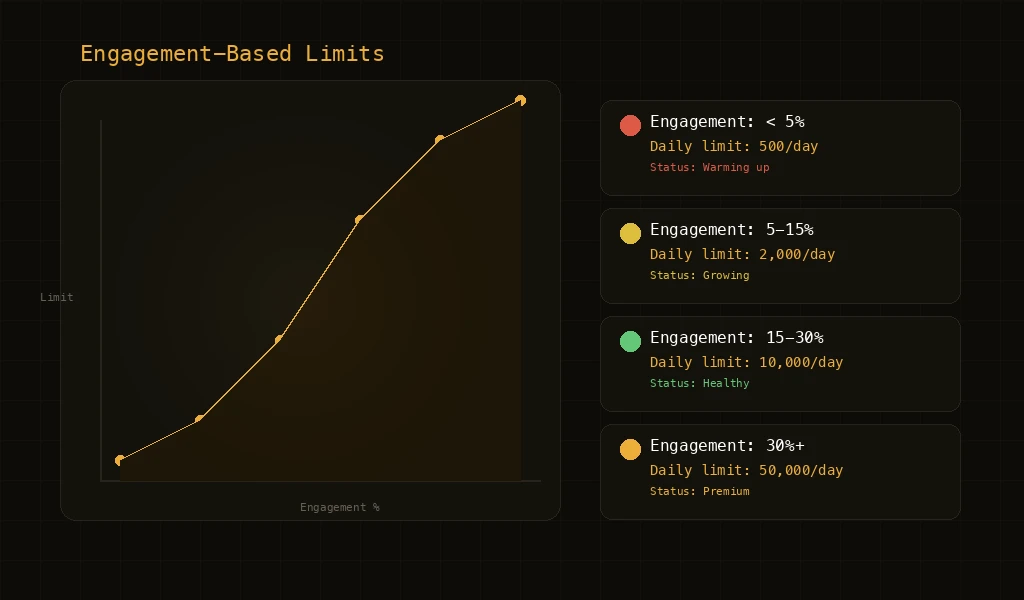
Static daily limits are either too generous or too restrictive. Engagement-based limits adapt to your actual performance — here's the logic behind them.
Every email platform enforces daily sending limits. The question is how those limits are determined. The simplest approach is static limits: you sign up for a plan with a fixed number of emails per day, and that's your ceiling. The problem is that static limits ignore the single most important factor in email deliverability — your actual sending performance and recipient engagement. Engagement-based limits take a fundamentally different approach: your daily capacity is calculated dynamically based on how your recipients interact with your email, how ISPs respond to your sending, and your historical track record.
Why Static Limits Don't Work
Static limits create a one-size-fits-all constraint that fits nobody well. A sender with excellent engagement and clean lists is artificially constrained by a limit designed for average senders. A sender with poor list hygiene and low engagement is given more capacity than they should have, allowing them to damage their reputation before hitting the ceiling. Static limits also can't adapt to changing conditions. If a sender's engagement drops significantly — indicating list fatigue or content problems — a static limit continues allowing the same volume of increasingly unwelcome email.
Inputs to Engagement-Based Limits
- Historical Sending Performance: The system analyzes weeks or months of sending data — average daily volume, peak volumes, growth trends. This historical baseline prevents sudden spikes while allowing organic growth.
- Engagement Metrics: Open rates, click rates, and reply rates directly influence limit calculations. High engagement signals that recipients value your email, justifying higher volume. Declining engagement triggers more conservative limits.
- Bounce and Complaint Rates: Elevated bounce rates or ISP complaints reduce the calculated limit. These are hard gates — above certain thresholds, limits are reduced regardless of other metrics.
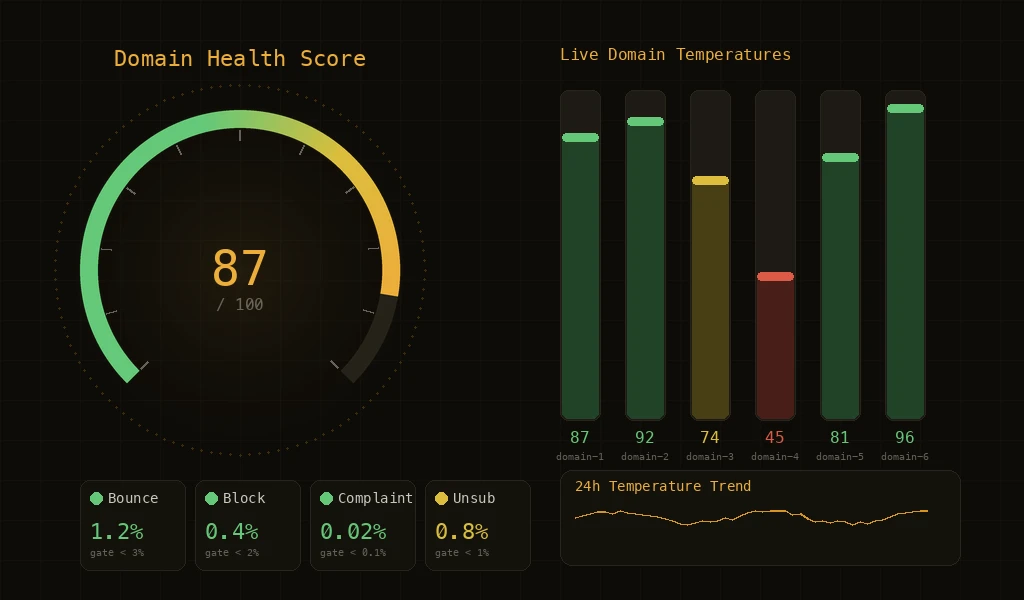
- Domain Health Score: The overall health score acts as a scaling factor on the calculated limit. A domain with a score of 90 gets nearly full capacity. A domain with a score of 50 gets roughly half. This creates a direct relationship between reputation and allowed volume.
Growth Caps and Spike Protection
Even with excellent engagement, a dynamic system needs to prevent volume spikes. If your average daily volume is 10,000 emails, jumping to 50,000 overnight will raise ISP suspicion regardless of your reputation. Engagement-based systems typically cap daily growth as a multiple of your recent average — allowing steady organic growth while preventing the kind of sudden volume increases that trigger ISP scrutiny. This growth cap protects senders from their own success — a viral marketing campaign that suddenly generates 10x normal sign-ups shouldn't also generate 10x email volume on day one.
How Limits Evolve Over Time
- New Domain Phase: Fresh domains start with conservative fixed limits during warmup. These aren't engagement-based yet because there's not enough data. The system uses predetermined tiers that increase as the domain ages and builds history.
- Transition to Dynamic Limits: Once a domain has sufficient sending history (typically several weeks), the system transitions from fixed tiers to dynamic calculation. The limit now reflects actual performance rather than predetermined values.
- Steady-State Operation: In steady state, limits recalculate periodically based on the latest data. Good performance gradually increases capacity. Declining performance gradually reduces it. The system maintains stability while allowing organic growth.
- Emergency Override: If a domain's health score drops below a critical threshold, the system overrides normal calculations and applies emergency limits regardless of historical performance. This prevents a rapidly deteriorating domain from using cached high limits.
Day Boundary Management
One subtle challenge in dynamic limits is the day boundary. When does 'today' end and 'tomorrow' begin? The system needs to calculate tomorrow's limit before today ends, so senders can plan campaigns. This means projecting tomorrow's limit based on today's performance trends — a projected limit that gets locked in at the day boundary and can only be overridden by emergency conditions. This projection mechanism prevents limits from fluctuating throughout the day, which would make campaign planning impossible.
The Feedback Loop
Engagement-based limits create a virtuous cycle for responsible senders. Good sending practices lead to high engagement, which leads to higher limits, which enables more sending, which (if done responsibly) maintains high engagement. Conversely, poor practices lead to declining engagement, which reduces limits, which forces senders to improve their practices before they can scale again. This feedback loop incentivizes exactly the behavior that ISPs reward: sending email that recipients actually want to receive.
Key Features
Dynamic Calculation
Daily limits calculated from historical performance, engagement metrics, and domain health — not static plan tiers.
Growth-Aware
Spike protection caps prevent sudden volume increases while allowing steady organic growth aligned with engagement.
Further Reading
For more tutorials and deep dives, head back to the blog.