Domain Health Scores and Email Warmup: How Automated Systems Protect New Senders
New sending domains face a cold start problem. Learn how domain health scoring and automated warmup systems solve it — without manual guesswork.
When you register a new sending domain, ISPs know nothing about you. You have no history, no engagement data, and no trust. Sending a large volume of email from a brand-new domain is one of the fastest ways to land in spam folders — or get blocked entirely. This is the cold start problem, and it affects every business that adds a new sending domain. The solution is a combination of domain health scoring and structured warmup — and increasingly, the best platforms automate this process entirely.
What Is a Domain Health Score?
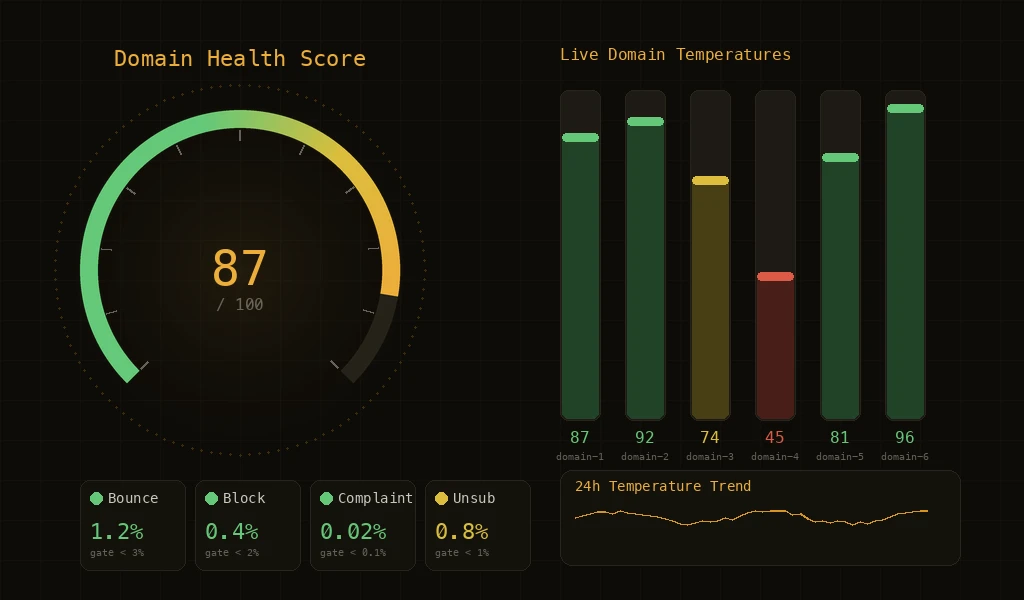
A domain health score is a numerical representation of your sending domain's reputation, typically on a 0-100 scale. It reflects how ISPs perceive your domain based on a blend of signals: bounce rates, block rates, complaint rates, engagement metrics, and historical sending patterns. A high score means ISPs trust your domain and are likely to deliver your emails to the inbox. A low score means your emails face increased scrutiny, throttling, or outright rejection. Unlike basic bounce rate monitoring, a health score synthesizes multiple signals into a single actionable metric that reflects your domain's overall standing across ISPs.
How Health Scores Are Calculated
- Historical Performance Blending: Effective health scores don't just look at today's data. They blend recent performance with longer-term trends — giving more weight to recent activity while using historical data for stability. This prevents a single bad hour from tanking your reputation.
- ISP Response Signals: Bounces, blocks, deferrals, and complaints from ISPs are the primary inputs. Each signal type carries different weight — complaints are more damaging than soft bounces, and blocks indicate more severe issues than deferrals.
- Engagement Metrics: Opens, clicks, and replies contribute positively. High engagement tells ISPs that recipients want your email, which improves inbox placement and feeds back into a higher health score.
- Sending Pattern Consistency: Sudden volume spikes or irregular sending patterns raise flags. Consistent, predictable sending behavior contributes to a stable health score over time.
The Warmup Problem for New Domains
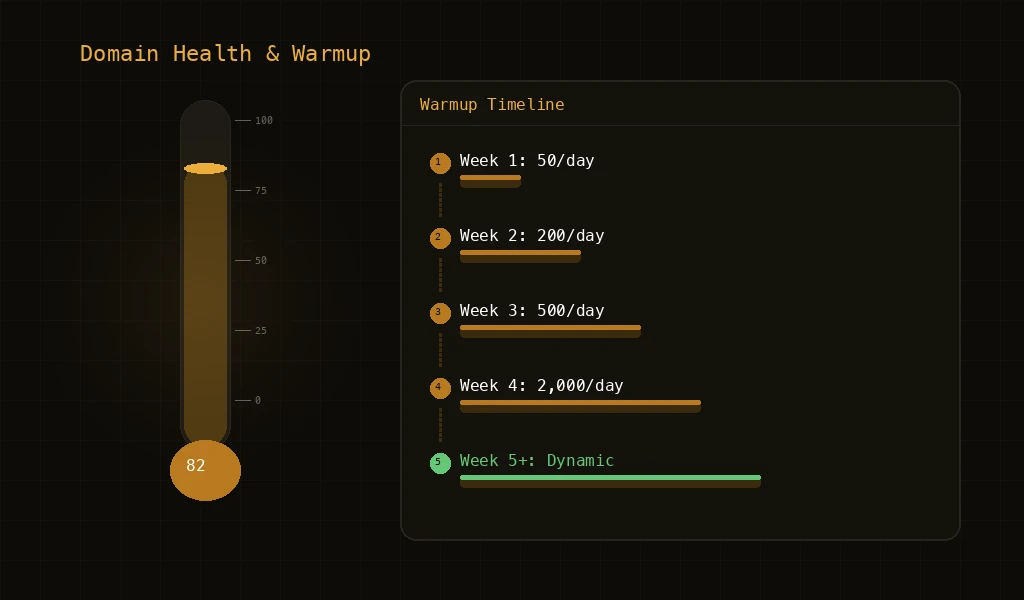
New domains start with no reputation — not a bad reputation, but an unknown one. ISPs treat unknown senders with caution. If you immediately start sending thousands of emails from a new domain, ISPs will likely throttle or block you because they have no basis to trust your domain. Warmup is the process of gradually increasing sending volume while building positive engagement signals. It typically takes 2-4 weeks for a new domain to establish enough trust for full-volume sending. The challenge is that warmup requires careful volume management — too slow and you waste time, too fast and you damage the reputation you're trying to build.
How Automated Warmup Works
- Initial Low-Volume Stage: The system starts with a conservative daily limit for the new domain. Only a small number of emails are sent per day, ensuring that ISPs see consistent, clean traffic from the domain.
- Engagement Monitoring: At each stage, the system monitors engagement signals — are emails being opened? Are bounces low? Are there any complaints? The domain only advances to higher volumes when metrics indicate positive reception.
- Progressive Volume Increases: When engagement meets the threshold criteria, the daily volume limit increases to the next tier. Each jump is calibrated to be large enough to make progress but small enough to not trigger ISP suspicion.
- Transition to Dynamic Limits: Once the domain has enough sending history and a stable health score, the system transitions from fixed warmup tiers to dynamic volume management — where limits are calculated based on ongoing performance rather than predetermined steps.
Why Manual Warmup Fails
Many teams attempt warmup manually — setting calendar reminders to increase volume every few days. This approach fails for several reasons. First, it requires constant attention from someone who understands deliverability. Second, it doesn't respond to real-time signals — if ISPs start throttling mid-warmup, a manual process won't catch it until damage is done. Third, manual warmup is inconsistent across domains when you manage multiple sending domains simultaneously. Automated warmup eliminates these problems by continuously monitoring ISP responses and adjusting volume as signals arrive.
Domain Health Score in Practice
In a well-designed system, the domain health score isn't just a dashboard metric — it directly influences sending behavior. When the score is high, the system allows full sending capacity. When it drops, the system automatically reduces volume or speed to prevent further damage. This creates a feedback loop: good sending behavior maintains a high score, which maintains high capacity, which enables more sending. Conversely, problematic sending triggers protective measures that preserve the domain's long-term reputation at the cost of short-term volume.
Key Features
Live Health Monitoring
Continuous health score calculation blending historical performance with live ISP signals for an always-current view of domain reputation.
Progressive Warmup
Automated volume increases based on engagement metrics ensure new domains build reputation safely without manual intervention.
Further Reading
For more tutorials and deep dives, head back to the blog.